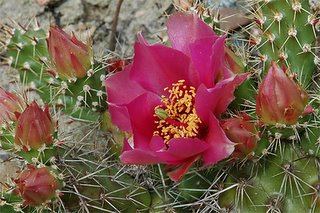
I have no previous experience growing Conophytum but last year I fell for a nice specimen of the genus and it’s now growing in my coldhouse. Conophytum is a typical winter-grower – in habitat it’s distributed in the arid winter rainfall areas from southern Namibia to the western part of South Africa. Consequently Conophytum must be treated fundamentally differently to cacti.
Flowering Conophytum sp. – close-up
Conophytums must have a summer resting period, during which the existing leaves dry up to papery sheaths that protect next season’s budding leaves. Watering is resumed in late summer and new leaves develop rapidly, tearing apart the protective sheath formed by the old leaves. The plants should be watered quite heavily during the growth period; flowers are usually also produced during this period. When autumn sets in watering must be greatly reduced or completely stopped.
Flowering Conophytum sp.
In spite of my lack of experience in growing plants from this genus, my Conophytum sp. rewarded me with two flowers a couple of days ago. I have no clue what species my plant is, but it seems to be standing the cold quite well (apparently frost-free conditions are recommended for Conophytums in general).
If anyone can decide the species based on the photos I would very much like to know. Also recommendations of other Conophytum species that can be grown under unheated glass (in freezing environments) would be greatly appreciated.
Saturday, September 15, 2007
Flowering Conophytum sp.
Wednesday, August 15, 2007
Flowering Opuntia tortispina
Back in 2004 I ordered a batch of plants from Uhlig-Kakteen in Germany including two Opuntia tortispina (DJF 1139; west Albuquerque, New Mexico). The plants arrived in late summer and spent their first winter outdoors in a large pot placed near a south facing wall. In 2005 one of the plants was transplanted to an unprotected bed; this plant flowered for the first time this summer but unfortunately the flowers never unfolded completely because of rainy and overcast weather.
Opuntia tortispina flower
My unprotected beds are located in the northern parts of Denmark only a couple hundred meters (yards) from the North Sea and the plants are often exposed to strong, salty westerlies. Most of my plants seem to thrive in these conditions with O. tortispina as one of the exceptions – it grows slowly and has orange-brown, barky patches on all cladodes.
Opuntia tortispina in unprotected bed
The plant still growing in the pot protected by a house wall is more than double in size, and all cladodes are an immaculate green; on the other hand this plant never flowered ;-) Unfortunately I forgot to take pictures for comparison.
You can find details on other Opuntia plants that flowered in the summer of 2007 in these posts: Opuntia fragilis (Butte Co, Nebraska), Opuntia polyacantha, Opuntia 'Claude Arno'.
Tuesday, August 14, 2007
Black slugs feasting on Delosperma
The gastropods thrived during the wet weather spell that haunted Denmark a couple of weeks ago – especially black slugs (Arion ater) were abundant in my area. The slugs seem to have a preference for the turgid, succulent leaves of Delosperma nubigenum (Sani Pass, 2900m, Lesotho), grazing off large parts of the plant.
Two black slugs feasting on Delosperma
I don’t know if the slugs don’t find the Delosperma nubigenum flowers palatable or if the attention of the leftmost slug was otherwise diverted. 
A close escape - the flower survives
Anyway, the flower escaped being eaten and I removed the slugs from the plant just after taking the above pictures.
Fortunately the weather has dried up considerably, forcing the slugs and snails into hiding.
Thursday, July 19, 2007
New growth and missed opportunities
As mentioned in the previous post the last month has been extremely wet in Denmark. Some of my plants seem to thrive in the humid environment and are setting new growth while the plants just about to flower haven’t exactly rejoiced in the rain.
Last year I planted 4 Opuntia compressa (Monmouth County, New Jersey) seedlings in one of my beds. The plants were started from seed in 2004 (Mesa Garden described the plants as “cold and wet – no problem” in their catalogue, and they are head-on). The new cladodes are still a fresh lime-green and are bearing reddish-brown leaves.
Opuntia compressa (Monmouth Co, NJ), new growth
At the age of 3 the plants are setting their first flowers – I’m hoping for some sun for the flowers to develop properly.
Opuntia compressa (Monmouth Co, NJ) setting flowers
I’ve had my Opuntia 'Smithwick' plant for several years and it never felt like flowering – until now. Unfortunately many of the flowers haven’t fully developed because of the weather and have ended up as “duds”.
Opuntia 'Smithwick' flower buds ready to flower but withered before they got the chance
Still others have been maimed by gastropods (snails, slugs, what have you) wallowing in the rain.
Opuntia 'Smithwick' flower bud maimed by snails
Tuesday, July 17, 2007
Opuntia 'Claude Arno' flowering in the rain
Usually my Opuntias are displaying a wealth of flowers at this time of year, but it’s been raining for weeks now in Denmark, holding the flowers back. The wet weather was preceded by a hot and sunny period resulting in a lot of flower buds; unfortunately many of these will end up as “duds” because of the rain.
Luckily some plants like Opuntia 'Claude Arno' are insisting on flowering even though the chances for being visited by pollinating insects are slim in this weather.
Opuntia 'Claude Arno' flowering in the rain, close-up
Still the plants look pretty miserably in the rain with only half-opened flowers.
Opuntia 'Claude Arno' flowering in the rain
The wet weather has one other unfortunate side effect: hordes of snails and slugs are stampeding through my beds causing havoc for new growth, flower buds, and other tender parts of the plants. The day after the above photos were taken the sun shone, giving the flowers a chance to open fully – to no avail though as most anthers had been shaven off of the stamens, by gastropods I presume.
Opuntia 'Claude Arno' missing anthers
Fortunately I haven’t seen any traces of the Iberian slug (Arion lusitanicus) that has spread up through Europe and is now thriving in the Scandinavian climate to such a degree that it’s nick-named the “killer slug”.
You can find details on other Opuntia plants that flowered in the summer of 2007 in these posts: Opuntia fragilis (Butte Co, Nebraska), Opuntia polyacantha, Opuntia tortispina (Albuquerque, New Mexico).
Tuesday, June 26, 2007
Flowering Opuntia polyacantha
Last year I didn’t experience a single of the many flowers set by my Opuntia polyacantha. Fortunately a visit to my summerhouse (where my winter hardy cacti beds are located) coincided with the flowering of the Opuntia polyacantha this summer.
Opuntia polyacantha flower, close-up
The plant is growing in the middle of my oldest cactus bed and soon needs pruning – otherwise it will spread into the neighboring Opuntia 'Smithwick' and Opuntia humifusa plants (seen respectively in the front and background of the below picture). The wild poppies also have to go; I found them charming when small but now they are taking up too much space.
Opuntia polyacantha in cactus bed
Like Opuntia humifusa flowers the flowers of Opuntia polyacantha are popular with bumble bees.
Bumble bee indulging in the pleasures of pollen and nectar
Even the slightly spent flowers from the day before are fancied by the bees.
Bumble bee leaving a flower
You can find details on other Opuntia plants that flowered in the summer of 2007 in these posts: Opuntia fragilis (Butte Co, Nebraska), Opuntia 'Claude Arno', Opuntia tortispina (Albuquerque, New Mexico).
Flowering Opuntia fragilis
Many of my Opuntia plants are flowering early this year including one of my favorites, Opuntia fragilis (Butte Co, Nebraska) with beautiful yellow, red-tinted flowers displaying red filaments, yellow anthers, and green stigma lobes. 
Opuntia fragilis flower, close-up
Last year the plant was moved to a new bed resulting in very few flowers. Now the plant has settled into its new location and the old growth is budding with flowers.
Opuntia fragilis at its new location
Opuntia fragilis, flower buds
You can find details on other Opuntia plants that flowered in the summer of 2007 in these posts: Opuntia polyacantha, Opuntia 'Claude Arno', Opuntia tortispina (Albuquerque, New Mexico).
Thursday, June 14, 2007
Delosperma – early flowers, take 3
Delosperma 'John Proffit' is flowering as the last of my Delosperma plants, displaying a wealth of attractive purple flowers with bright white centers.
Delosperma 'John Proffit', close-up
Delosperma 'John Proffit' is a vigorous, almost aggressive, grower. The plant has taken over a good part of one of my cactus beds, leaving a Cylindropuntia viridiflora stranded in a sea of purple flowers.
Sprawling Delosperma 'John Proffit'
For an illustration of the prolific growth you can compare the above plant with the same plant 10 months ago.
Tuesday, May 29, 2007
Delosperma – early flowers, take 2
As mentioned in the previous post my Delosperma plants are currently flowering. The latest addition to the flower feast is Delosperma nubigenum (Sani Pass, 2900m, Lesotho) boasting buttery yellow flowers.
Delosperma nubigenum (Sani Pass, Lesotho), close-up
The plant is forming a compact mat and has – like my other Delosperma plants – grown considerably in the year I’ve had it.
Delosperma nubigenum (Sani Pass, Lesotho)
Last week the Delosperma sp. (Sani Pass, Lesotho) plant was completely hidden by flowers; most of these have withered and the plant is now visible again._20070526.jpg)
Delosperma sp. (Sani Pass, Lesotho)
Since last week the Delosperma sp. (Drakensberg) plant has unfolded all its flower buds and now forms a carpet of purple flowers._20070526.jpg)
Delosperma sp. (Drakensberg)
Now I’m just waiting for my Delosperma 'John Proffit' to flower.
Tuesday, May 22, 2007
Delosperma – early flowers
As mentioned in a previous post I’m a Delosperma novice and consequently hadn’t expected the plants to be flowering this early, but two of the species I’m growing flowered abundantly this weekend (I’m not sure if it’s a coincidence or a pattern but my other two species flowered very late last autumn)._close-up_20070517.jpg)
Delosperma sp. (Sani Pass, Lesotho), close-up
The Delosperma sp. (Sani Pass, Lesotho) plant is completely hidden by flowers – I’m curious if it can keep up this pace during summer, or if it will be all spent in a couple of weeks._20070517.jpg)
Delosperma sp. (Sani Pass, Lesotho)
The Delosperma sp. (Drakensberg) is currently flowering along the edges of the plant but flower buds abound everywhere on the plant, so maybe it’s just a matter of time before this one will be completely covered in flowers as well._20070517.jpg)
Delosperma sp. (Drakensberg)_close-up_20070517.jpg)
Delosperma sp. (Drakensberg), close-up
Friday, April 20, 2007
Budding spring - Rhodiola and Opuntia
My Rhodiola rosea plants are coming out of winter in great shape. A couple of years ago I collected a handful of rhizomes from habitat in Greenland and now grow the plants in an unprotected bed along with my hardy cacti. The Rhodiola rosea plants originate from the hills above Hospitalsdalen (Hospital Valley), a place named after an American military hospital built in connection with the Bluie West One airfield during the 2nd World War. The hills are situated a few kilometers north east of Narsarsuaq and from the top you have a direct view of the Greenland Ice Sheet – I guess the location says it all regarding the plants cold tolerance ;-)
Rhodiola rosea (Narsarsuaq, Greenland)
I’m a bit curious as to whether I have both male and female plants; when I dug up the rhizomes I didn’t know the plants were dioecious, so even though they were flowering at the time I didn’t pay attention to their sex.
Allegedly Rhodiola rosea is categorized as an adaptogen with various health-promoting effects (like e.g. Panax ginseng), but I have no experience with these aspects of the plant.
My Opuntias are also breaking out of dormancy and beginning to set new growth, as illustrated by the pictures below.
Opuntia tortispina (DJF 1139; west Albuquerque, New Mexico)
Opuntia hystricina (DJF 1138; Bernalillo County, New Mexico)
Thursday, April 12, 2007
A visit to the New York Botanical Garden
I spent my Easter vacation in NYC and of course had to visit the New York Botanical Garden while in the neighborhood. The Easter weather was extremely cold with temperatures just above freezing – the cacti in the outdoor bed were all dormant so they seemed better prepared for the cold spell than we were ;-)
The NYBG outdoor cactus bed seems to be established or rearranged recently as very few of the plants are large and well established, one of the exceptions being a sprawling Opuntia pusilla.
Opuntia pusilla
View of cactus bed
Some of the dormant plants displayed beautiful winter colors, especially the O. basilaris and O. polyacantha cultivars were dazzling in their different shades of purple.
Opuntia basilaris 'Art Combe'
Opuntia polyacantha 'Candy Cane'
The Escobaria vivipara plants are growing just next to the footpath. Fortunately they weren’t trampled – in their withered state they could easily be overlooked if one swerved from the path.
Escobaria vivipara
The bed contains several species of Echinocereus, all looking fine after the winter. Inspired by this I might try to grow both Escobaria and Echinocereus in my unprotected bed (after investigating the differences in temperature and precipitation between Denmark and New York more thoroughly).
Echinocereus fendleri
Echinocereus dasyacanthus
A post on the NYBG cactus house (part of the Enid A. Haupt Conservatory) can be found here.
Posted by
Winter Hardy Cacti
at
9:29 PM
0
comments
Labels: Botanical Gardens, Echinocereus, Escobaria, Opuntia, Winter
Wednesday, March 28, 2007
Pictures from the coldhouse
The plants in the coldhouse were watered for the first time this season a couple of days ago. They have been kept abstinent from water since the beginning of their dormancy in late October, i.e. for almost 5 months. I’m fascinated by the patterns created by light and shadow on the withered cladodes, and had to take a couple of photos before the plants return to their usual turgid state.
Opuntia compressa (Monmouth County, New Jersey)
Opuntia kaibabensis (SB 1319; Houserock Valley, Arizona)
Opuntia polyacantha var. hystricina (Grand Canyon, Arizona)
The O. polyacantha var. hystricina plants are grown from seeds I collected during a hike down the Grand Canyon.
Escobaria vivipara (south Alberta, Canada)
This E. vivipara has sunken almost completely in on itself. As the stem swells with water the tubercles will soon be fully erect and protruding again.
Wednesday, March 21, 2007
Opuntia – post winter status, 2007
As mentioned in yesterdays Delosperma post, this winter has been extremely wet in Denmark but not very cold. All of my cacti, growing in unprotected beds, seem to be coping very well with the conditions, though.
Opuntia polyacantha (Redcliff, Alberta, Canada)
My two Opuntia polyacantha (Redcliff, Alberta, Canada) plants were started from seed (bought from Mesa Garden) in 2004. They spent their first couple of years growing protected in a coldhouse, and were transplanted to an unprotected bed late last spring.
The unprotected Cylindropuntia viridiflora (Pojoaque, New Mexico, USA) plant has been very marked by winter in previous years, but made it through this winter virtually without a scratch.
Cylindropuntia viridiflora (Pojoaque, New Mexico)
The only sign of winter on last years new growth is a slight blushing (displayed against a rusty-red carpet of winter dressed Delosperma 'John Proffit').
Cylindropuntia viridiflora (Pojoaque, New Mexico) – new growth
In general the plants are not as withered as they usually are at this time of year, as is evident from the (mostly) turgid cladodes of this Opuntia tortispina (DJF 1139; w. Albuquerque, New Mexico, USA).
Opuntia tortispina (Albuquerque, New Mexico)
The C. viridiflora and O. tortispina plants were both bought from Uhlig-Kakteen.
BTW, I just realized today is the vernal equinox – a suitable day to post on the status after winter ;-)
Tuesday, March 20, 2007
Delosperma – all dressed up for winter
This winter has been wet, wet, wet in Denmark, but not all that cold. It’s probably not the optimal environment for Delosperma, but the four species I’m currently cultivating certainly don’t seem to mind their growing conditions. Most of the plants have assumed a reddish hue as illustrated by the photos below. All plants are growing in unprotected beds.
Delosperma nubigenum (Sani Pass, 2900m, Lesotho)
Delosperma sp. 'John Proffit' (East Cape Drakensberg)_20070317.jpg)
Delosperma sp. (Sani Pass, Lesotho)
Only the Delosperma sp. (Drakensberg) is its usual bright green self, showing only slight traces of red pigmentation._20070317.jpg)
Delosperma sp. (Drakensberg)